This page walks through the Neovim configuration I use day-to-day on Windows. It assumes you already have Lazy.nvim set up as the package manager — every plugin spec below is a *.lua file under your namespace directory that require("namespace.lazy") will pick up.
Folder layout
On Windows the config file is init.lua and it lives at:
C:\Users\<user>\AppData\Local\nvim\init.lua
Inside the same nvim directory, create a namespace folder (I use kaekeshan) and split the config into separate files:
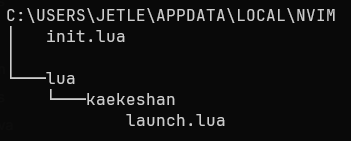
The three files you need first:
| File | Purpose |
|---|---|
launch.lua | Defines LAZY_PLUGIN_SPEC (a global table) and a spec(item) helper to register plugins. |
options.lua | Core vim.opt settings — clipboard, splits, indent, search behaviour, etc. |
keymaps.lua | Global keymaps — leader key, window navigation, mouse-driven LSP, Tab/S-Tab behaviour. |
init.lua pulls them together:
require("namespace.launch")   -- registers plugins
require("namespace.options")
require("namespace.keymaps")
launch.lua
A small helper that builds the global plugin table lazy.nvim consumes:
LAZY_PLUGIN_SPEC = {} -- global table variable

function spec(item)
    table.insert(LAZY_PLUGIN_SPEC, {import = item}) -- adds imports received as inputs
end
options.lua
Core editor options. These are the values that have stuck over time — paste, tweak, restart:
vim.opt.backup = false           -- don't create a backup file
vim.opt.clipboard = "unnamedplus" -- share with system clipboard
vim.opt.cmdheight = 1             -- more space in the command line
vim.opt.completeopt = {"menuone", "noselect"} -- mostly for cmp
vim.opt.conceallevel = 0          -- so that `` is visible in markdown files
vim.opt.hlsearch = true           -- highlight all matches on previous search
vim.opt.ignorecase = true         -- ignore case in search patterns
vim.opt.mouse = "a"               -- allow the mouse everywhere
vim.opt.pumheight = 10            -- popup menu height
vim.opt.pumblend = 10
vim.opt.showmode = false          -- hide the "-- INSERT --" indicator
vim.opt.showtabline = 1           -- always show tabs
vim.opt.smartcase = true
vim.opt.smartindent = true
vim.opt.splitbelow = true         -- horizontal splits go below current window
vim.opt.splitright = true         -- vertical splits go to the right
vim.opt.swapfile = false
vim.opt.termguicolors = true      -- enable GUI colors in the terminal
vim.opt.timeoutlen = 1000         -- ms to wait for a mapped sequence
vim.opt.undofile = true           -- persistent undo
vim.opt.updatetime = 100          -- faster completion (default 4000ms)
vim.opt.writebackup = false

vim.opt.expandtab = true          -- tabs -> spaces
vim.opt.shiftwidth = 2
vim.opt.tabstop = 2
vim.opt.cursorline = true
vim.opt.number = true
vim.opt.laststatus = 3
vim.opt.showcmd = false
vim.opt.ruler = false
vim.opt.relativenumber = true
vim.opt.numberwidth = 4
vim.opt.signcolumn = "yes"        -- prevents text shifting when signs toggle
vim.opt.wrap = false
vim.opt.scrolloff = 0
vim.opt.sidescrolloff = 8
vim.opt.guifont = "monospace:h17"
vim.opt.title = false

vim.opt.fillchars = vim.opt.fillchars + "eob: "
vim.opt.fillchars:append {
    stl = " "
}

vim.opt.shortmess:append "c"

vim.cmd "set whichwrap+=<,>,[,],h,l"
vim.cmd [[set iskeyword+=-]]

vim.g.netrw_banner = 0
vim.g.netrw_mouse = 2
keymaps.lua
Leader-key setup, window navigation, mouse-driven LSP popups, and visual-mode helpers:
local keymap = vim.keymap.set
local opts = {noremap = true, silent = true}

-- Leader key: Space
keymap("n", "<Space>", "", opts)
vim.g.mapleader = " "
vim.g.maplocalleader = " "

keymap("n", "<C-i>", "<C-i>", opts)

-- Better window navigation (Alt + hjkl)
keymap("n", "<m-h>", "<C-w>h", opts)
keymap("n", "<m-j>", "<C-w>j", opts)
keymap("n", "<m-k>", "<C-w>k", opts)
keymap("n", "<m-l>", "<C-w>l", opts)
keymap("n", "<m-tab>", "<c-6>", opts)

-- Stay in indent mode
keymap("v", "<", "<gv", opts)
keymap("v", ">", ">gv", opts)

-- Paste in visual mode without yanking
keymap("x", "p", [["_dP]])

-- Mouse menu (right-click and Tab)
vim.cmd [[:amenu 10.100 mousemenu.Goto\ Definition <cmd>lua vim.lsp.buf.definition()<CR>]]
vim.cmd [[:amenu 10.110 mousemenu.References <cmd>lua vim.lsp.buf.references()<CR>]]
vim.keymap.set("n", "<RightMouse>", "<cmd>:popup mousemenu<CR>")
vim.keymap.set("n", "<Tab>", "<cmd>:popup mousemenu<CR>")

-- Shift-h/l jump to first/last non-blank
keymap({"n", "o", "x"}, "<s-h>", "^", opts)
keymap({"n", "o", "x"}, "<s-l>", "g_", opts)

-- gj/gk for soft-wrapped lines
keymap({"n", "x"}, "j", "gj", opts)
keymap({"n", "x"}, "k", "gk", opts)

-- Toggle wrap
keymap("n", "<leader>w", ":lua vim.wo.wrap = not vim.wo.wrap<CR>", opts)

-- Exit terminal insert mode with Ctrl-;
vim.api.nvim_set_keymap("t", "<C-;>", "<C-\\><C-n>", opts)
Plugins
Each subsection below is one plugin spec file. They all share the same local SPEC = { ... }; function SPEC.config() ... end; return SPEC shape.
Dev-Icons
File-type icons in UI elements (completion menu, tree, statusline).
- Repository: nvim-tree/nvim-web-devicons
local devicons = {
    "nvim-tree/nvim-web-devicons",
    event = "VeryLazy"
}

function devicons.config()
    require "nvim-web-devicons"
end

return devicons
Tree-sitter
Incremental parsing-based syntax highlighting and indentation.
- Repository: nvim-treesitter/nvim-treesitter
local SPEC = {
    "nvim-treesitter/nvim-treesitter",
    event = {"BufReadPost", "BufNewFile"},
    build = ":TSUpdate"
}

function SPEC.config()
    require "nvim-treesitter.install".compilers = {"zig"} -- install zig via system package manager
    require("nvim-treesitter.configs").setup {
        ensure_installed = {
            "lua", "markdown", "markdown_inline",
            "bash", "python", "c", "cpp", "rust",
            "java", "javascript", "html", "css", "csv"
        },
        highlight = {enable = true},
        indent = {enable = true}
    }
end

return SPEC
Manage parsers with
:TSUpdate,:TSInstall <lang>,:TSUninstall <lang>.
Hardtime
Discourages bad habits (e.g. repeated h/j/k/l instead of word motions) by briefly blocking the key.
- Repository: m4xshen/hardtime.nvim
local SPEC = {
    "m4xshen/hardtime.nvim",
    dependencies = {"MunifTanjim/nui.nvim", "nvim-lua/plenary.nvim"},
    opts = {}
}

function SPEC.config()
    require("hardtime").setup()
end

return SPEC
Mason + Mason-LSPConfig
Package manager for LSP servers, linters, formatters. The list below is the set of servers I auto-install:
- Repository: williamboman/mason-lspconfig.nvim
local SPEC = {
    "williamboman/mason-lspconfig.nvim",
    dependencies = {
        "williamboman/mason.nvim"
    }
}

function SPEC.config()
    local servers = {
        "clangd",
        "cssls",
        "jsonls",
        "quick_lint_js",
        "jedi_language_server",
        "rust_analyzer",
        "sqlls",
        "biome",
        "lemminx",
        "html",
        "lua_ls",
        "jdtls",
        "marksman"
    }

    require("mason").setup {
        ui = {border = "rounded"}
    }

    require("mason-lspconfig").setup {
        ensure_installed = servers
    }
end

return SPEC
Schemastore
JSON schema catalog, used by jsonls to validate configs.
- Repository: b0o/SchemaStore.nvim
local SPEC = {
    "b0o/schemastore.nvim",
    lazy = true
}

function SPEC.config()
end

return SPEC
Lspconfig
The main LSP wiring — buffer keymaps, capabilities, per-server setups. Per-server settings live under lua/user/lspsettings/<server>.lua; see Neovim - LSP for examples.
- Repository: neovim/nvim-lspconfig
local SPEC = {
    "neovim/nvim-lspconfig",
    event = {"BufReadPre", "BufNewFile"},
    dependencies = {
        {
            "folke/neodev.nvim"
        }
    }
}

local function lsp_keymaps(bufnr)
    local opts = {noremap = true, silent = true}
    local keymap = vim.api.nvim_buf_set_keymap
    keymap(bufnr, "n", "gD", "<cmd>lua vim.lsp.buf.declaration()<CR>", opts)
    keymap(bufnr, "n", "gd", "<cmd>lua vim.lsp.buf.definition()<CR>", opts)
    keymap(bufnr, "n", "K",  "<cmd>lua vim.lsp.buf.hover()<CR>",       opts)
    keymap(bufnr, "n", "gI", "<cmd>lua vim.lsp.buf.implementation()<CR>", opts)
    keymap(bufnr, "n", "gr", "<cmd>lua vim.lsp.buf.references()<CR>",  opts)
    keymap(bufnr, "n", "gl", "<cmd>lua vim.diagnostic.open_float()<CR>", opts)
end

SPEC.on_attach = function(client, bufnr)
    lsp_keymaps(bufnr)

    if client.supports_method "textDocument/inlayHint" then
        vim.lsp.inlay_hint.enable(bufnr, true)
    end
end

function SPEC.common_capabilities()
    local capabilities = vim.lsp.protocol.make_client_capabilities()
    capabilities.textDocument.completion.completionItem.snippetSupport = true
    return capabilities
end

SPEC.toggle_inlay_hints = function()
    local bufnr = vim.api.nvim_get_current_buf()
    vim.lsp.inlay_hint.enable(bufnr, not vim.lsp.inlay_hint.is_enabled(bufnr))
end

function SPEC.config()
    local wk = require "which-key"
    wk.register {
        ["<leader>la"] = {"<cmd>lua vim.lsp.buf.code_action()<cr>", "Code Action"},
        ["<leader>lf"] = {
            "<cmd>lua vim.lsp.buf.format({async = true, filter = function(client) return client.name ~= 'typescript-tools' end})<cr>",
            "Format"
        },
        ["<leader>li"] = {"<cmd>LspInfo<cr>", "Info"},
        ["<leader>lj"] = {"<cmd>lua vim.diagnostic.goto_next()<cr>", "Next Diagnostic"},
        ["<leader>lh"] = {"<cmd>lua require('user.lspconfig').toggle_inlay_hints()<cr>", "Hints"},
        ["<leader>lk"] = {"<cmd>lua vim.diagnostic.goto_prev()<cr>", "Prev Diagnostic"},
        ["<leader>ll"] = {"<cmd>lua vim.lsp.codelens.run()<cr>", "CodeLens Action"},
        ["<leader>lq"] = {"<cmd>lua vim.diagnostic.setloclist()<cr>", "Quickfix"},
        ["<leader>lr"] = {"<cmd>lua vim.lsp.buf.rename()<cr>", "Rename"}
    }

    wk.register {
        ["<leader>la"] = {
            name = "LSP",
            a = {"<cmd>lua vim.lsp.buf.code_action()<cr>", "Code Action", mode = "v"}
        }
    }

    local lspconfig = require "lspconfig"
    local icons = require "kaekeshan.icons" -- extra dependency

    local servers = {
        "clangd", "cssls", "jsonls", "quick_lint_js",
        "jedi_language_server", "rust_analyzer", "sqlls",
        "biome", "lemminx", "html", "lua_ls", "jdtls", "marksman"
    }

    local default_diagnostic_config = {
        signs = {
            active = true,
            values = {
                {name = "DiagnosticSignError",  text = icons.diagnostics.Error},
                {name = "DiagnosticSignWarn",   text = icons.diagnostics.Warning},
                {name = "DiagnosticSignHint",   text = icons.diagnostics.Hint},
                {name = "DiagnosticSignInfo",   text = icons.diagnostics.Information}
            }
        },
        virtual_text = false,
        update_in_insert = false,
        underline = true,
        severity_sort = true,
        float = {
            focusable = true,
            style = "minimal",
            border = "rounded",
            source = "always",
            header = "",
            prefix = ""
        }
    }

    vim.diagnostic.config(default_diagnostic_config)

    for _, sign in ipairs(vim.tbl_get(vim.diagnostic.config(), "signs", "values") or {}) do
        vim.fn.sign_define(sign.name, {texthl = sign.name, text = sign.text, numhl = sign.name})
    end

    vim.lsp.handlers["textDocument/hover"]         = vim.lsp.with(vim.lsp.handlers.hover,         {border = "rounded"})
    vim.lsp.handlers["textDocument/signatureHelp"] = vim.lsp.with(vim.lsp.handlers.signature_help, {border = "rounded"})
    require("lspconfig.ui.windows").default_options.border = "rounded"

    for _, server in pairs(servers) do
        local opts = {
            on_attach = SPEC.on_attach,
            capabilities = SPEC.common_capabilities()
        }

        local require_ok, settings = pcall(require, "user.lspsettings." .. server)
        if require_ok then
            opts = vim.tbl_deep_extend("force", settings, opts)
        end

        if server == "lua_ls" then
            require("neodev").setup {}
        end

        lspconfig[server].setup(opts)
    end
end

return SPEC
Two required dependencies for
lspconfig
Icons
The icons table used by lspconfig, cmp, and devicons to render glyphs for kinds, git statuses, diagnostics, and UI elements. This is a data file — keep it as is, or fork the icon mappings to your taste.
Show the icons catalog
return {
    kind = {
        Array = " ",
        Boolean = " ",
        Class = " ",
        Color = " ",
        Constant = " ",
        Constructor = " ",
        Enum = " ",
        EnumMember = " ",
        Event = " ",
        Field = " ",
        File = " ",
        Folder = " ",
        Function = " ",
        Interface = " ",
        Key = " ",
        Keyword = " ",
        Method = " ",
        Module = " ",
        Namespace = " ",
        Null = " ",
        Number = " ",
        Object = " ",
        Operator = " ",
        Package = " ",
        Property = " ",
        Reference = " ",
        Snippet = " ",
        String = " ",
        Struct = " ",
        Text = " ",
        TypeParameter = " ",
        Unit = " ",
        Value = " ",
        Variable = " "
    },
    git = {
        LineAdded = " ",
        LineModified = " ",
        LineRemoved = " ",
        FileDeleted = " ",
        FileIgnored = "◌",
        FileRenamed = " ",
        FileStaged = "S",
        FileUnmerged = " ",
        FileUnstaged = "",
        FileUntracked = "U",
        Diff = " ",
        Repo = " ",
        Octoface = " ",
        Copilot = " ",
        Branch = ""
    },
    ui = {
        ArrowCircleDown = "",
        ArrowCircleLeft = "",
        ArrowCircleRight = "",
        ArrowCircleUp = "",
        BoldArrowDown = "",
        BoldArrowLeft = "",
        BoldArrowRight = "",
        BoldArrowUp = "",
        BoldClose = "",
        BoldDividerLeft = "",
        BoldDividerRight = "",
        BoldLineLeft = "▎",
        BoldLineMiddle = "┃",
        BoldLineDashedMiddle = "┋",
        BookMark = " ",
        BoxChecked = " ",
        Bug = " ",
        Stacks = "",
        Scopes = "",
        Watches = "",
        DebugConsole = " ",
        Calendar = " ",
        Check = " ",
        ChevronRight = "",
        ChevronShortDown = "",
        ChevronShortLeft = "",
        ChevronShortRight = "",
        ChevronShortUp = "",
        Circle = " ",
        Close = "",
        CloudDownload = " ",
        Code = "",
        Comment = "",
        Dashboard = "",
        DividerLeft = "",
        DividerRight = "",
        DoubleChevronRight = "»",
        Ellipsis = "",
        EmptyFolder = " ",
        EmptyFolderOpen = " ",
        File = " ",
        FileSymlink = "",
        Files = " ",
        FindFile = "",
        FindText = "",
        Fire = " ",
        Folder = " ",
        FolderOpen = " ",
        FolderSymlink = " ",
        Forward = " ",
        Gear = " ",
        History = " ",
        Lightbulb = " ",
        LineLeft = "▏",
        LineMiddle = "│",
        List = " ",
        Lock = " ",
        NewFile = " ",
        Note = " ",
        Package = " ",
        Pencil = " ",
        Plus = " ",
        Project = " ",
        Search = " ",
        SignIn = " ",
        SignOut = " ",
        Tab = "",
        Table = " ",
        Target = " ",
        Telescope = " ",
        Text = " ",
        Tree = "",
        Triangle = "",
        TriangleShortArrowDown = "",
        TriangleShortArrowLeft = "",
        TriangleShortArrowRight = "",
        TriangleShortArrowUp = ""
    },
    diagnostics = {
        BoldError = "",
        Error = " ",
        BoldWarning = "",
        Warning = " ",
Which-Key
Pops up a hint when you start a leader-key sequence and you pause. The mappings table below lists every <leader>… group I expose.
- Repository: folke/which-key.nvim
local SPEC = {
    "folke/which-key.nvim"
}

function SPEC.config()
    local mappings = {
        q = {"<cmd>confirm q<CR>", "Quit"},
        h = {"<cmd>nohlsearch<CR>", "NOHL"},
        [";"] = {"<cmd>tabnew | terminal<CR>", "Term"},
        v = {"<cmd>vsplit<CR>", "Split"},
        b = {name = "Buffers"},
        d = {name = "Debug"},
        f = {name = "Find"},
        g = {name = "Git"},
        l = {name = "LSP"},
        p = {name = "Plugins"},
        t = {name = "Test"},
        a = {
            name = "Tab",
            n = {"<cmd>$tabnew<cr>", "New Empty Tab"},
            N = {"<cmd>tabnew %<cr>", "New Tab"},
            o = {"<cmd>tabonly<cr>", "Only"},
            h = {"<cmd>-tabmove<cr>", "Move Left"},
            l = {"<cmd>+tabmove<cr>", "Move Right"}
        },
        T = {name = "Treesitter"}
    }

    local which_key = require "which-key"
    which_key.setup {
        plugins = {
            marks = true,
            registers = true,
            spelling = {enabled = true, suggestions = 20},
            presets = {
                operators = false, motions = false, text_objects = false,
                windows = false, nav = false, z = false, g = false
            }
        },
        window = {border = "rounded", position = "bottom", padding = {2, 2, 2, 2}},
        ignore_missing = true,
        show_help = false,
        show_keys = false,
        disable = {buftypes = {}, filetypes = {"TelescopePrompt"}}
    }

    which_key.register(mappings, {mode = "n", prefix = "<leader>"})
end

return SPEC
Cmp (nvim-cmp)
Completion engine with sources for LSP, snippets, buffer, path, emoji, and Copilot.
- Repository: hrsh7th/nvim-cmp
local SPEC = {
    "hrsh7th/nvim-cmp",
    event = "InsertEnter",
    dependencies = {
        { "hrsh7th/cmp-nvim-lsp",    event = "InsertEnter" },
        { "hrsh7th/cmp-emoji",       event = "InsertEnter" },
        { "hrsh7th/cmp-buffer",      event = "InsertEnter" },
        { "hrsh7th/cmp-path",        event = "InsertEnter" },
        { "hrsh7th/cmp-cmdline",     event = "InsertEnter" },
        { "saadparwaiz1/cmp_luasnip",event = "InsertEnter" },
        { "L3MON4D3/LuaSnip",        event = "InsertEnter",
            dependencies = { "rafamadriz/friendly-snippets" } },
        { "hrsh7th/cmp-nvim-lua" }
    }
}

function SPEC.config()
    local cmp = require "cmp"
    local luasnip = require "luasnip"
    require("luasnip/loaders/from_vscode").lazy_load()

    vim.api.nvim_set_hl(0, "CmpItemKindCopilot", {fg = "#6CC644"})
    vim.api.nvim_set_hl(0, "CmpItemKindTabnine", {fg = "#CA42F0"})
    vim.api.nvim_set_hl(0, "CmpItemKindEmoji",   {fg = "#FDE030"})

    local check_backspace = function()
        local col = vim.fn.col "." - 1
        return col == 0 or vim.fn.getline("."):sub(col, col):match "%s"
    end

    local icons = require "kaekeshan.icons"

    cmp.setup {
        snippet = {
            expand = function(args)
                luasnip.lsp_expand(args.body)
            end
        },
        mapping = cmp.mapping.preset.insert {
            ["<C-k>"]       = cmp.mapping(cmp.mapping.select_prev_item(), {"i", "c"}),
            ["<C-j>"]       = cmp.mapping(cmp.mapping.select_next_item(), {"i", "c"}),
            ["<Down>"]      = cmp.mapping(cmp.mapping.select_next_item(), {"i", "c"}),
            ["<Up>"]        = cmp.mapping(cmp.mapping.select_prev_item(), {"i", "c"}),
            ["<C-b>"]       = cmp.mapping(cmp.mapping.scroll_docs(-1), {"i", "c"}),
            ["<C-f>"]       = cmp.mapping(cmp.mapping.scroll_docs(1),  {"i", "c"}),
            ["<C-Space>"]   = cmp.mapping(cmp.mapping.complete(),       {"i", "c"}),
            ["<C-e>"]       = cmp.mapping { i = cmp.mapping.abort(), c = cmp.mapping.close() },
            ["<CR>"]        = cmp.mapping.confirm {select = true},
            ["<Tab>"]       = cmp.mapping(
                function(fallback)
                    if cmp.visible() then
                        cmp.select_next_item()
                    elseif luasnip.expandable() then
                        luasnip.expand()
                    elseif luasnip.expand_or_jumpable() then
                        luasnip.expand_or_jump()
                    elseif check_backspace() then
                        fallback()
                    else
                        fallback()
                    end
                end,
                { "i", "s" }
            ),
            ["<S-Tab>"]     = cmp.mapping(
                function(fallback)
                    if cmp.visible() then
                        cmp.select_prev_item()
                    elseif luasnip.jumpable(-1) then
                        luasnip.jump(-1)
                    else
                        fallback()
                    end
                end,
                { "i", "s" }
            )
        },
        formatting = {
            fields = {"kind", "abbr", "menu"},
            format = function(entry, vim_item)
                vim_item.kind = icons.kind[vim_item.kind]
                vim_item.menu =
                    ({
                        nvim_lsp = "", nvim_lua = "", luasnip = "",
                        buffer = "", path = "", emoji = ""
                    })[entry.source.name]

                if entry.source.name == "emoji" then
                    vim_item.kind = icons.misc.Smiley
                    vim_item.kind_hl_group = "CmpItemKindEmoji"
                end

                if entry.source.name == "cmp_tabnine" then
                    vim_item.kind = icons.misc.Robot
                    vim_item.kind_hl_group = "CmpItemKindTabnine"
                end

                return vim_item
            end
        },
        sources = {
            {name = "copilot"},
            {name = "nvim_lsp"},
            {name = "luasnip"},
            {name = "cmp_tabnine"},
            {name = "nvim_lua"},
            {name = "buffer"},
            {name = "path"},
            {name = "calc"},
            {name = "emoji"}
        },
        confirm_opts = {behavior = cmp.ConfirmBehavior.Replace, select = false},
        window = {
            completion  = {border = "rounded", scrollbar = false},
            documentation = {border = "rounded"}
        },
        experimental = {ghost_text = false}
    }
end

return SPEC
None-ls
Local formatting sources that don’t need an LSP — runs stylua, prettier, black, clang-format, google-java-format on save.
- Repository: nvimtools/none-ls.nvim
local SPEC = {
    "nvimtools/none-ls.nvim",
    dependencies = {
        "nvim-lua/plenary.nvim"
    }
}

function SPEC.config()
    local null_ls = require "null-ls"

    local formatting = null_ls.builtins.formatting
    local diagnostics = null_ls.builtins.diagnostics

    null_ls.setup {
        debug = false,
        sources = {
            formatting.stylua,
            formatting.prettier,
            formatting.black,
            formatting.clang_format,
            formatting.google_java_format
            -- formatting.prettier.with { extra_filetypes = { "toml" } },
            -- formatting.eslint,
            -- diagnostics.flake8,
        }
    }
end

return SPEC